
Heads get the headlines, but the shaft decides how a club launches, flies, and feels. That's why H-G builds its own filament-wound graphite, pairs it with proven KBS steel, and matches the right one to your swing in a live fitting.
Get Fitted for Yours See the Lineup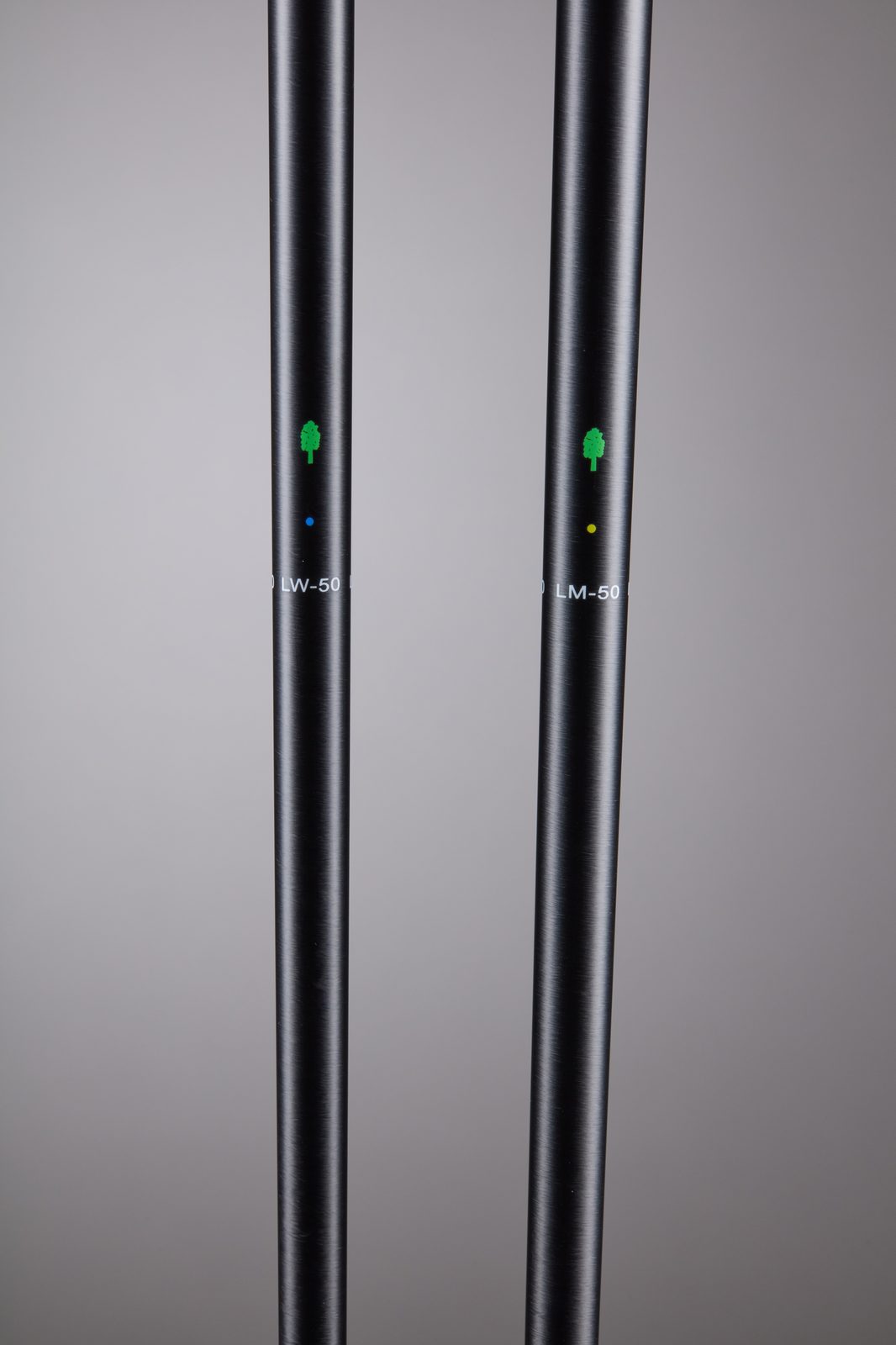
A shaft that's too stiff robs you of feel and distance. One that's too soft balloons and scatters. Weight, flex, and kick point together decide your launch, spin, and dispersion — which is why your H-G fitter treats the shaft as a fitting variable, never a default.
Two steel shafts cover the full launch spectrum — one that helps the ball up, one that flights it down.
For players who want help getting the ball airborne without giving up the stability of steel.
For strong, high ball-speed strikers who flight it down and want control without ballooning.
Played H-G for years? If you knew our Kicker or Dynamic steel: the KBS Tour Lite now fills the Kicker's easy-launch role, and the KBS Tour carries the Dynamic's penetrating, lower-flight role. Your fitter can translate your old spec directly.
Our proprietary filament-wound graphite line runs from a 75-gram tour profile to a 45-gram maximum-launch build, so there's a right answer at every swing speed.
You'll see these color bands on every H-G fitting cart — the same code your fitter uses to move you between flexes during a fitting.
Three things decide most of what a shaft does for you. Here's the short version your fitter proves on the lie board.
The shaft flexes lower toward the tip, adding loft at impact and helping the ball get airborne. Ideal for moderate swing speeds or players who struggle to launch it.
The shaft holds firmer through the tip and delays release. Suits strong, high ball-speed strikers who want control and less ballooning.
Lighter graphite (45–75 g) generally promotes more speed and easier launch; heavier steel (105–130 g) promotes stability and control.
Most graphite shafts sold today are tape-rolled: sheets of graphite cut into flags and rolled onto a mandrel, largely by hand, because it's cheaper and easier to produce. H-G chose the harder path — filament winding — and spent 25 years perfecting it: proprietary hardware that brings low-angle fiber close to zero degrees, winding programs that keep the fiber intact and the surface true, and tight resin control so there's never dry fiber.
That work closed the one advantage tape-rolling ever had — bending stiffness in ultralight designs — while keeping everything winding does better. Every H-G graphite shaft is also wound with 90-degree hoop-strength fiber from butt to tip, so the shaft resists ovaling under load and delivers your power to the head instead of losing it to deformation. The payoff: higher power efficiency, higher initial ball speed, and a club that stays stable through impact.
Over 95% continuous fiber from butt to tip for smooth, efficient power transfer.
Uniform wall thickness at every section — seamless, with no gaps or overlaps.
Fiber angle and lay-up controlled by machine, so every shaft is built the same way.
Fibers wound around a rotating mandrel stay symmetric to the centerline — uniform properties all the way around.
| Property | H-G Filament Winding | Tape Rolling (industry standard) |
|---|---|---|
| Fiber continuity | Over 95% continuous fiber butt to tip; under 5% lost to grinding. | Only 30–40% continuous fiber from butt to tip. |
| Wall thickness | Uniform at any section; seamless, no gaps or overlaps. | Controllable only at the two end sections; gap and overlap areas. |
| Fiber angle & lay-up | CNC-controlled for unprecedented repeatability. | Cut and rolled by different operators; poor repeatability. |
| Fiber symmetry | Wound over rotating mandrels, highly symmetric to the centerline. | Rolled sheets change fiber direction; cannot be symmetrical. |

Every shaft that goes through SST PURE alignment is also graded for symmetry, from A to C, by rotating it under load. H-G shafts bend to the same position through a full 360 degrees — and SST PURE founder Dick Weiss has remarked more than once that the rate of A-grade shafts coming from H-G simply doesn't occur across the rest of the industry. We've also engineered consistent frequency gaps between flexes, matched across graphite and steel, so moving flex to flex in a fitting is a true apples-to-apples comparison.
It's fitted. Your certified H-G fitter will put these shafts in your hands, show you the ball flight change, and build your set around the one that fits — PUREd, frequency-matched, and made for your swing.
Find a Certified FitterLoading cart...